Topic 1 · Question 50
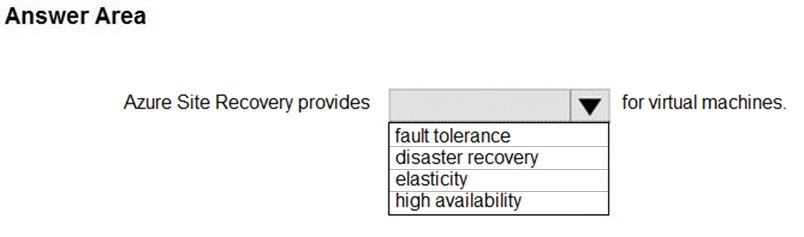
To complete the sentence, select the appropriate option in the answer area.
Hot Area:
Top comment
KP_MSA▲ 554Highly votedFebruary 04, 2021 11:06 pm
The answer here should be "disaster recovery"
16 more highly voted comments
joesome▲ 51Highly votedSeptember 13, 2021 02:51 pm
"Disaster Recovery", got it 13 September 2021
DH▲ 42Highly votedFebruary 05, 2021 08:23 pm
https://docs.microsoft.com/en-us/azure/site-recovery/site-recovery-overview
You can set up disaster recovery of Azure VMs from a primary region to a secondary region.
ans:disaster recovery
You can set up disaster recovery of Azure VMs from a primary region to a secondary region.
ans:disaster recovery
Fire_Starter▲ 30Highly votedApril 10, 2021 10:14 pm
Disaster recovery is a whole replica of the data center set up and not just a single VM. IF a single VM has issues, fault tolerance should be able to cover for that downtime, hence Azure site recovery set up
blobstorage▲ 23Highly votedJanuary 26, 2022 06:17 pm
Fault tolerance is correct.
Fault tolerance is a cloud service that remains *available after* a failure occurs.
Disaster Recovery is a cloud service that can be *recovered after* a failure occurs.
Azure Recovery Services contributes to your BCDR strategy:
Site Recovery service: Site Recovery helps ensure business continuity by keeping business apps and workloads running during outages. Site Recovery replicates workloads running on physical and virtual machines (VMs) from a primary site to a secondary location. When an outage occurs at your primary site, you fail over to secondary location, and access apps from there. After the primary location is running again, you can fail back to it.
Backup service: The Azure Backup service keeps your data safe and recoverable.
Taken from https://docs.microsoft.com/en-us/azure/site-recovery/site-recovery-overview
xhkpgkfrilchupiysb▲ 15Highly votedSeptember 21, 2021 12:33 pm
The page about site recovery now clearly states "Azure Site Recovery
Keep your business running with built-in disaster recovery service" so I agree
https://azure.microsoft.com/en-us/services/site-recovery/
Keep your business running with built-in disaster recovery service" so I agree
https://azure.microsoft.com/en-us/services/site-recovery/
DennisWitjes▲ 15Highly votedFebruary 05, 2021 02:05 pm
https://azure.microsoft.com/en-us/services/site-recovery/. Agreed!
eliow▲ 14Highly votedNovember 28, 2022 06:48 am
No, it is fault tolerance because site recovery according to Microsoft documentation ensure business continuity by keeping business apps and workloads during outages.
Site Recovery service: Site Recovery helps ensure business continuity by keeping business apps and workloads running during outages.
https://learn.microsoft.com/en-us/azure/site-recovery/site-recovery-overview
Site Recovery service: Site Recovery helps ensure business continuity by keeping business apps and workloads running during outages.
https://learn.microsoft.com/en-us/azure/site-recovery/site-recovery-overview
jimzhang▲ 12Highly votedJune 18, 2021 06:36 am
Passed on 18 June 2021with 985, got this question in my exam and the correct answer is disaster recovery!!!
Fosnefes▲ 10Highly votedFebruary 15, 2023 12:26 pm
After deeper analysis, I changed my mind. Sorry for that!!
Azure Site Recovery provides resilience and disaster recovery for apps and workloads running on on-premises machines.
Azure Site Recovery provides resilience and disaster recovery for apps and workloads running on on-premises machines.
LeShen▲ 9Highly votedNovember 28, 2022 09:53 pm
Azure Site Recovery provides resilience and disaster recovery for apps and workloads running on on-premises machines, or Azure IaaS VMs - From Microsoft
MOsama1▲ 9Highly votedMarch 31, 2021 03:38 pm
Disaster recovery is the recovery of a service after a failure. For example, restoring a virtual machine from backup after a virtual machine failure.
https://searchdisasterrecovery.techtarget.com/definition/cloud-disaster-recovery-cloud-DR
https://searchdisasterrecovery.techtarget.com/definition/cloud-disaster-recovery-cloud-DR
Roy_study▲ 8Highly votedMay 06, 2021 09:05 pm
Site Recovery contributes to your business continuity and disaster recovery (BCDR) strategy, by orchestrating and automating replication of Azure VMs between regions, on-premises virtual machines and physical servers to Azure, and on-premises machines to a secondary datacenter.
Bernal8▲ 7Highly votedFebruary 09, 2021 06:40 pm
If you read carefuly the explanation provided by Microsoft when talking about Azure Site Recovery, you realise that the answer given here is correct due to the fact that this service starts working just before the disaster occurs. Therefore, it is used for 'fault tolerance' and not for disaster recovering. This second option would be for example in case of that Azure Site Recovery started working once one APP is 100% down, and it is not the case.
asdqwerwq▲ 7Highly votedFebruary 05, 2021 01:23 pm
i agree