Topic 1 · Question 62
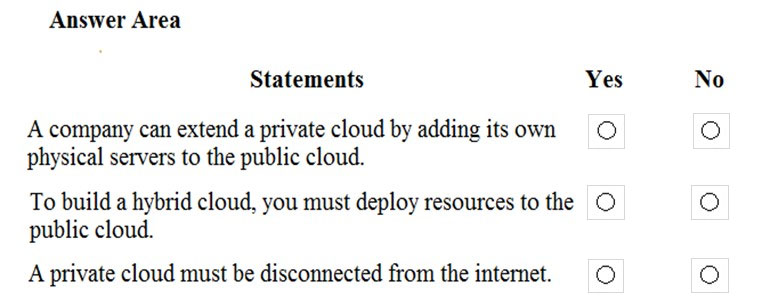
For each of the following statements, select Yes if the statement is true. Otherwise, select No.
NOTE: Each correct selection is worth one point.
Hot Area:
Top comment
elmo0002▲ 188Highly votedSeptember 10, 2021 11:36 am
Just got this question in the test, and I answered NYN. I got full scores at first section.
18 more highly voted comments
km_cloud▲ 150Highly votedMarch 17, 2021 04:38 am
I think, no, no, no
theManFromRoom5▲ 33Highly votedMarch 09, 2022 06:43 am
This is such a helpful comment. Thank you for not just saying 'came up in test'. Haha
theManFromRoom5▲ 33Highly votedMarch 09, 2022 06:43 am
This is such a helpful comment. Thank you for not just saying 'came up in test'. Haha
NasheM▲ 29Highly votedFebruary 22, 2021 02:45 pm
In hybrid you deploy to both public and private cloud. It doesn't say ONLY public but you have to have something deployed in public cloud, otherwise it's just private cloud not hybrid
Amitkj2989▲ 23Highly votedFebruary 20, 2021 06:24 am
Not sure about answer 2. You can deploy resources to private cloud as well in case of hybrid, why MUST deploy to public cloud only?
fuddyduddy▲ 17Highly votedMay 16, 2021 11:44 am
I agree N,N,N too. Here's why:
I have a tenant. I don't have any subscriptions. This means that I can't create any resources at all. (I do have a SPO web site but that is not an Azure Resource.)
But I use AAD Connect to sync some of my on-prem security principals (users and groups) to my tenant. This means that my environment is hybrid. I could even run Exchange Hybrid Configuration Wizard if I wanted.
So I have a hybrid environment without resources.
This means that you don't need to create resources in the cloud to be hybrid.
jecaine▲ 16Highly votedMay 10, 2021 08:47 pm
it says "Deploy." You can have a private and public cloud, but you don't have to deploy resources from your private cloud to the public cloud. you can add new resources that don't exist on your private cloud. For example: If John Smith exists in AD on your Domain Controller, you don't have to migrate his user record to AzureAD, you can add Susie Q separately, therefore you have a hybrid cloud but you're not deploying resources to the public cloud
Franco11▲ 15Highly votedMay 08, 2021 08:11 am
How can you Have Hybrid Cloud Without recourses on the public cloud?
kwekkwekforsale▲ 13Highly votedFebruary 11, 2021 08:40 am
because you cannot "physically" add your own servers to Microsoft's data center, which is the public cloud.
JustSignalingVirtues▲ 11Highly votedMay 29, 2022 05:06 pm
You deploy resources (VMs, DBs, Network Components)to public cloud.
dcdcdcdcdc▲ 8Highly votedFebruary 13, 2025 12:15 am
BUT YOU STILL NEED TO DEPLOY RESOURCES TO PUBLIC, SO IT SHOULD BE YES!
dcdcdcdcdc▲ 8Highly votedFebruary 13, 2025 12:15 am
BUT YOU STILL NEED TO DEPLOY RESOURCES TO PUBLIC, SO IT SHOULD BE YES!
Kanders▲ 7Highly votedFebruary 02, 2023 01:16 am
1. No
2. Yes
3. No
2. Yes
3. No
cab123▲ 7Highly votedApril 01, 2021 10:30 am
no, "must" means you have to, because you have to have something in the cloud, it does not mean "only"
cab123▲ 7Highly votedApril 01, 2021 10:30 am
no, "must" means you have to, because you have to have something in the cloud, it does not mean "only"
cab123▲ 7Highly votedApril 01, 2021 10:30 am
no, "must" means you have to, because you have to have something in the cloud, it does not mean "only"